Stamped metal parts sit at the foundation of modern industrial manufacturing. From automotive brackets and battery enclosures to office furniture frames and garage door hardware, metal stamping converts flat sheet metal into precise, repeatable components at a scale few other processes can match.
Metal stamping is a cold-forming manufacturing process in which flat metal sheet or coil stock is placed between a die and a punch, then shaped under high mechanical or hydraulic pressure. A single stamping press can perform blanking, piercing, bending, forming, and deep drawing operations, either in one hit or across a sequence of stations in a progressive die. The result is a part with tight dimensional repeatability, a clean surface finish, and a unit cost that drops sharply as production volume increases.
Because stamping reshapes metal through plastic deformation rather than removing material, it is inherently efficient with raw stock and well suited to medium- and high-volume programs. Engineering literature on sheet metal forming describes this in terms of a "forming window" in strain space — the safe zone in which a part can be drawn without tearing, necking, or wrinkling, bounded by the material's failure limits and shaped by the interaction between experimental measurement and numerical modeling of the stamping process. Staying inside that window is the core engineering challenge behind every stable, defect-free stamped part.
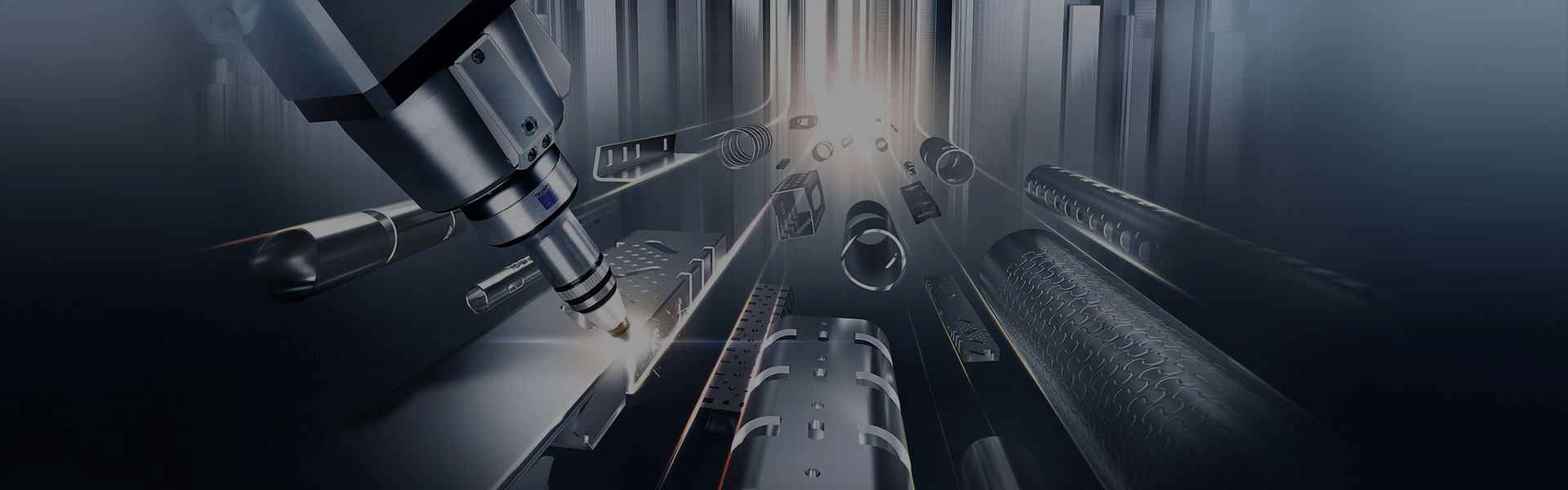
Most stamped metal parts are produced using one, or a combination, of the following processes:
| Process | Description | Typical Use |
|---|---|---|
| Blanking | Cutting a flat shape (blank) from sheet stock as the starting piece for further forming | Base shapes for brackets, panels, washers |
| Piercing / Punching | Removing material to create holes, slots, or cut-outs | Mounting holes, ventilation slots, fastener clearance |
| Bending | Plastically deforming sheet metal along a straight axis | Brackets, flanges, structural angles |
| Deep Drawing | Pulling a flat blank into a die cavity to form a cup or box shape | Housings, panels, enclosures |
| Progressive Stamping | A strip of metal advances through multiple stations in one continuous die, with a different operation performed at each stage | High-volume, complex geometry parts |
| Transfer Stamping | Individual blanks are mechanically transferred between separate die stations | Larger or more complex three-dimensional parts |
| Compound Stamping | Multiple operations (e.g., blanking and piercing) performed in a single press stroke at one station | Simple, high-precision flat parts |
ACRO Metal applies these processes across its stamping parts line, and pairs them with downstream welding and assembly operations when a finished, multi-component part is required rather than a single stamping.
Material choice affects formability, strength, corrosion resistance, weight, and cost. Common options include:
| Material | Key Properties | Common Applications |
|---|---|---|
| Carbon Steel | High strength, cost-effective, good formability | Structural brackets, frames, automotive components |
| Stainless Steel (304, 316) | Corrosion resistance, hygienic surface, durability | Kitchenware, medical parts, outdoor hardware |
| Aluminum Alloys | Lightweight, corrosion resistant, good thermal conductivity | Truck steps, EV enclosures, lightweight brackets |
| Copper & Brass | Electrical conductivity, corrosion resistance | Electrical contacts, connectors, decorative parts |
Material behavior under strain — including strain hardening, anisotropy, and fracture limits — is a core research theme in sheet metal forming literature, and directly informs how a die is designed for a given alloy and gauge. ACRO Metal's technical team accounts for these material-specific forming characteristics when developing new stamping and progressive dies for a customer's drawing.
| Treatment | Purpose |
|---|---|
| Zinc / Nickel Plating | Corrosion resistance, improved appearance |
| Powder Coating | Durable colored finish, added surface protection |
| E-Coating | Uniform corrosion protection on complex geometries, common in automotive parts |
| Anodizing | Hardened, corrosion-resistant oxide layer, mainly for aluminum |
| Passivation | Removes free iron from stainless steel surfaces to enhance corrosion resistance |
Precision stamping depends on die design, press tonnage, material gauge, and inspection. Typical parameters for custom stamped parts include:
| Parameter | Typical Range |
|---|---|
| Material thickness | 0.1 mm – 6.0 mm (custom ranges available) |
| Dimensional tolerance | ±0.01 mm to ±0.1 mm, depending on design and material |
| CMM positioning accuracy | 0.0001 mm |
| Maximum measurement range | 1000 × 1200 × 800 mm |
These figures reflect the equipment and inspection standards used by ACRO Metal's quality inspection process, which includes coordinate measuring machines (CMM), salt spray testing, projector inspection, film thickness gauges, and tensile testing performed on 100% of shipments.
Stamped metal parts serve structural, functional, and protective roles across a wide span of industries:
Automotive: Automotive metal stamping parts for body panels, chassis brackets, reinforcements, and battery housings — read more on the critical role of metal stamping in automotive manufacturing.
Trucks: Steps, filter screens, and structural supports built for heavy-duty service.
Furniture: Furniture metal stamping parts including frames, legs, connectors, and hinges.
Medical: Medical metal stamping parts requiring high cleanliness and tight tolerances.
Consumer goods & appliances: Appliance stamping parts, plus outdoor kitchenware such as pizza peels.
Door and hardware systems: Garage door end caps and brackets.
Leisure & sporting goods: Precision-formed slingshot frames and handles.
The perceived cost of metal stamping usually comes from tooling, not per-part production. As explored in detail in ACRO Metal's article "Is Metal Stamping a High-Cost Investment?", die design and manufacturing represent the largest upfront expense, while the incremental cost of each additional part drops significantly once the mold is in production. This makes stamping most economical for medium-to-large production runs, while very low-volume prototypes may be better suited to machining or 3D printing until volume justifies dedicated tooling.
Established in 2003, ACRO Metal Products Ltd. is a China-based custom stamping, welding, and assembly manufacturer with more than 20 years of production experience and business across 30+ countries.
| Capability | Detail |
|---|---|
| Press capacity | 80T–500T stamping and hydraulic presses |
| Monthly output | Up to 300,000 pieces/month; samples in 3–7 days |
| Equipment | AMADA CNC punching & bending, HAAS CNC center, Panasonic and Kawasaki robots |
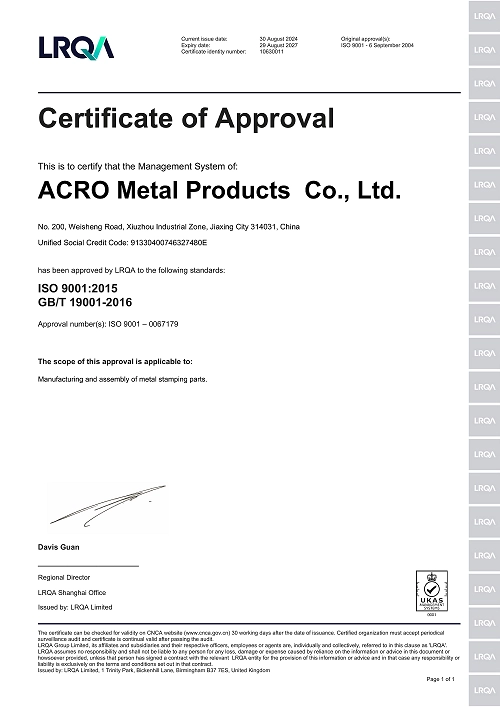
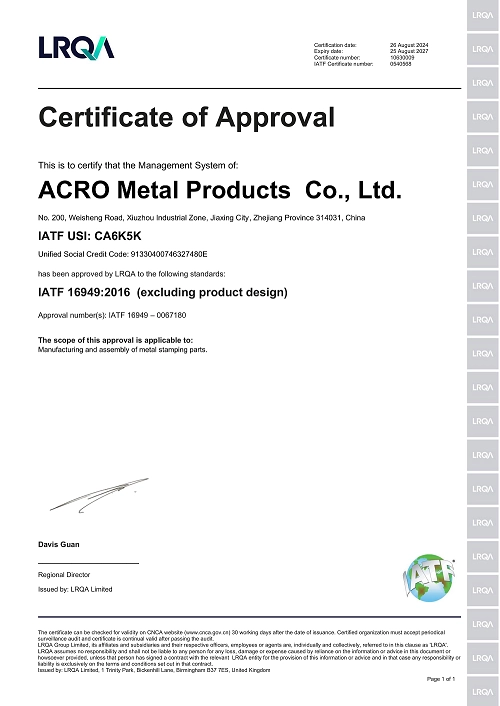
| Certifications | ISO 9001:2015, IATF 16949, ISO 14001, ISO 45001, RoHS, REACH |
| Engineering | In-house tooling design using AutoCAD, Pro-E, SolidWorks, UG, and CAE analysis |
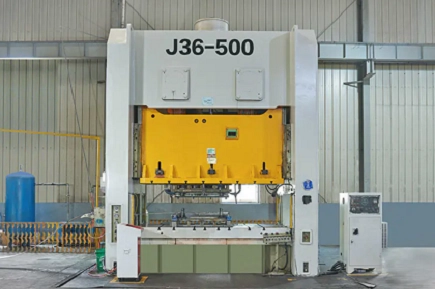
Beyond stamping itself, ACRO Metal's production equipment and technical advantages pages detail the company's independent tooling workshop, which designs and manufactures single-stage and progressive dies directly from customer drawings — an important factor in controlling both lead time and long-run part cost.
For readers tracking developments in the stamped metal parts sector — trade show participation, new certifications, and manufacturing capacity updates — ACRO Metal maintains an active Industry News section alongside its Company News page, including recent coverage of the company's participation at International Hardware Fair Cologne and the Canton Fair.
Stamped metal parts remain one of the most efficient, scalable, and reliable ways to manufacture precision metal components, provided the die design, material selection, and quality process are handled correctly from the start. Manufacturers evaluating a stamping partner should weigh tooling investment against production volume, required tolerances, and finishing needs. Companies such as ACRO Metal Products Ltd. combine in-house die design, certified quality systems, and high-tonnage press capacity to support both prototyping and full production runs — visit ACRO Metal's product catalog or contact the team directly to discuss a custom stamping project.